Published by:
CGP EDU Academic Team
Published on: September 12, 2026
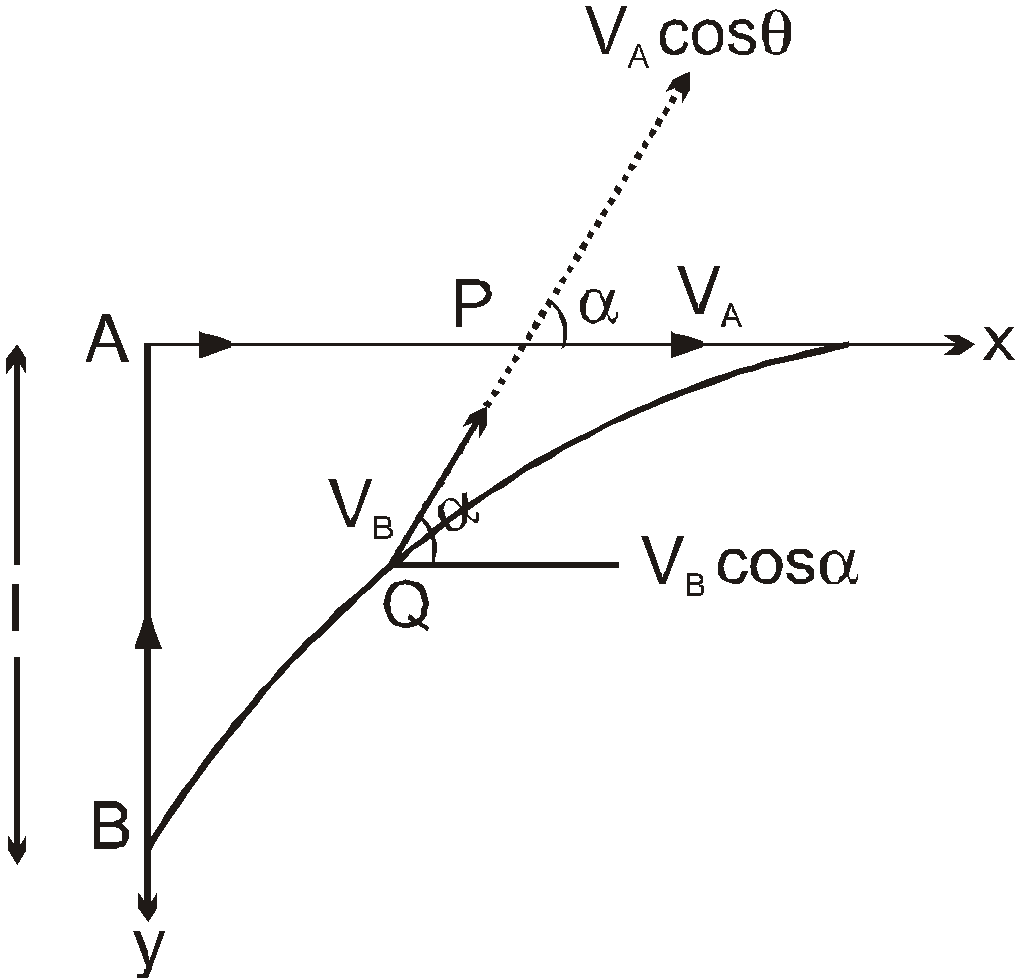
In the figure shown A and B are two particles which start from rest. A has constant acceleration ' a ' in the direction shown. B also increases its speed at a constant rate ' b ', but the direction of velocity is always towards A. Find the time after which B meets A. Also find the total distance travelled by B. (b > a)

Text Solution
Verified by ExpertsThe correct answer is:
A
Step 1: Define the motion of particle A.
Particle A starts from rest and moves with a constant acceleration 'a'. The distance covered by particle A after time 't' is given by:
$$d_A = rac{1}{2} a t^2$$
Step 2: Define the motion of particle B.
Particle B also starts from rest, but it has a constant acceleration 'b' towards particle A. The velocity of particle B at any time 't' can be expressed as:
$$v_B = b t$$
Since particle B is moving towards A while accelerating, we need to consider the change in the distance between them. The distance covered by B after a time 't' is given by:
$$d_B = rac{1}{2} b t^2$$
However, B is always trying to catch up with A, so its motion is affected by the decreasing distance between the two particles.
Step 3: Relative Motion Analysis.
Let the initial distance between A and B be 'd'. Particle B's effective acceleration towards A would be the difference in acceleration between the two particles.
Since B accelerates faster than A (given that b > a), they eventually meet. At the meeting point, total distance covered by B will equal the distance A has covered plus the initial distance.
So we set up the equation:
$$d_A + d = d_B$$
Substituting the equations for distances:
$$rac{1}{2} a t^2 + d = rac{1}{2} b t^2$$
So, we rearrange this to find the time at which they meet:
$$rac{1}{2} (b - a)t^2 = d$$
$$t^2 = rac{2d}{b - a} $$
$$t = rac{ ext{sqrt}(2d)}{ ext{sqrt}(b - a)}$$
Step 4: Calculate total distance traveled by B.
Using the time we found, the distance traveled by B can be found as follows:
$$d_B = rac{1}{2} b t^2$$
Substituting for 't':
$$d_B = rac{1}{2} b imes rac{2d}{b - a} = rac{bd}{b - a}$$
Thus, the time after which B meets A is: $$t = rac{ ext{sqrt}(2d)}{ ext{sqrt}(b - a)}$$
And the total distance traveled by B is: $$d_B = rac{bd}{b - a}$$.
Particle A starts from rest and moves with a constant acceleration 'a'. The distance covered by particle A after time 't' is given by:
$$d_A = rac{1}{2} a t^2$$
Step 2: Define the motion of particle B.
Particle B also starts from rest, but it has a constant acceleration 'b' towards particle A. The velocity of particle B at any time 't' can be expressed as:
$$v_B = b t$$
Since particle B is moving towards A while accelerating, we need to consider the change in the distance between them. The distance covered by B after a time 't' is given by:
$$d_B = rac{1}{2} b t^2$$
However, B is always trying to catch up with A, so its motion is affected by the decreasing distance between the two particles.
Step 3: Relative Motion Analysis.
Let the initial distance between A and B be 'd'. Particle B's effective acceleration towards A would be the difference in acceleration between the two particles.
Since B accelerates faster than A (given that b > a), they eventually meet. At the meeting point, total distance covered by B will equal the distance A has covered plus the initial distance.
So we set up the equation:
$$d_A + d = d_B$$
Substituting the equations for distances:
$$rac{1}{2} a t^2 + d = rac{1}{2} b t^2$$
So, we rearrange this to find the time at which they meet:
$$rac{1}{2} (b - a)t^2 = d$$
$$t^2 = rac{2d}{b - a} $$
$$t = rac{ ext{sqrt}(2d)}{ ext{sqrt}(b - a)}$$
Step 4: Calculate total distance traveled by B.
Using the time we found, the distance traveled by B can be found as follows:
$$d_B = rac{1}{2} b t^2$$
Substituting for 't':
$$d_B = rac{1}{2} b imes rac{2d}{b - a} = rac{bd}{b - a}$$
Thus, the time after which B meets A is: $$t = rac{ ext{sqrt}(2d)}{ ext{sqrt}(b - a)}$$
And the total distance traveled by B is: $$d_B = rac{bd}{b - a}$$.
Prepare Smarter with CGP Edu
Get practice questions, solutions, and test series in one place.
Write a Review
Share your experience with this question and solution.
Commentary
Send your comment, doubt, correction, or feedback to admin.
Similar Questions
Explore conceptually related problems
Two trains, each 50 m long are travelling in opposite direction with velocity 10 m/s and 15 m/s . T…
A 120 m long train is moving in a direction with speed 20 m/s . A train B moving with 30 m / s in t…
A 210 meter long train is moving due North at a of 25m/s. A small bird is flying due South a little…
A police jeep is chasing with, velocity of 45 km / h a thief in another jeep moving with velocity 1…
A boat is sent across a river with a velocity of 8 km/hr. If the resultant velocity of boat is 10 k…
A train of 150 meter length is going towards north direction at a speed of 10 cm/sec . A parrot fli…